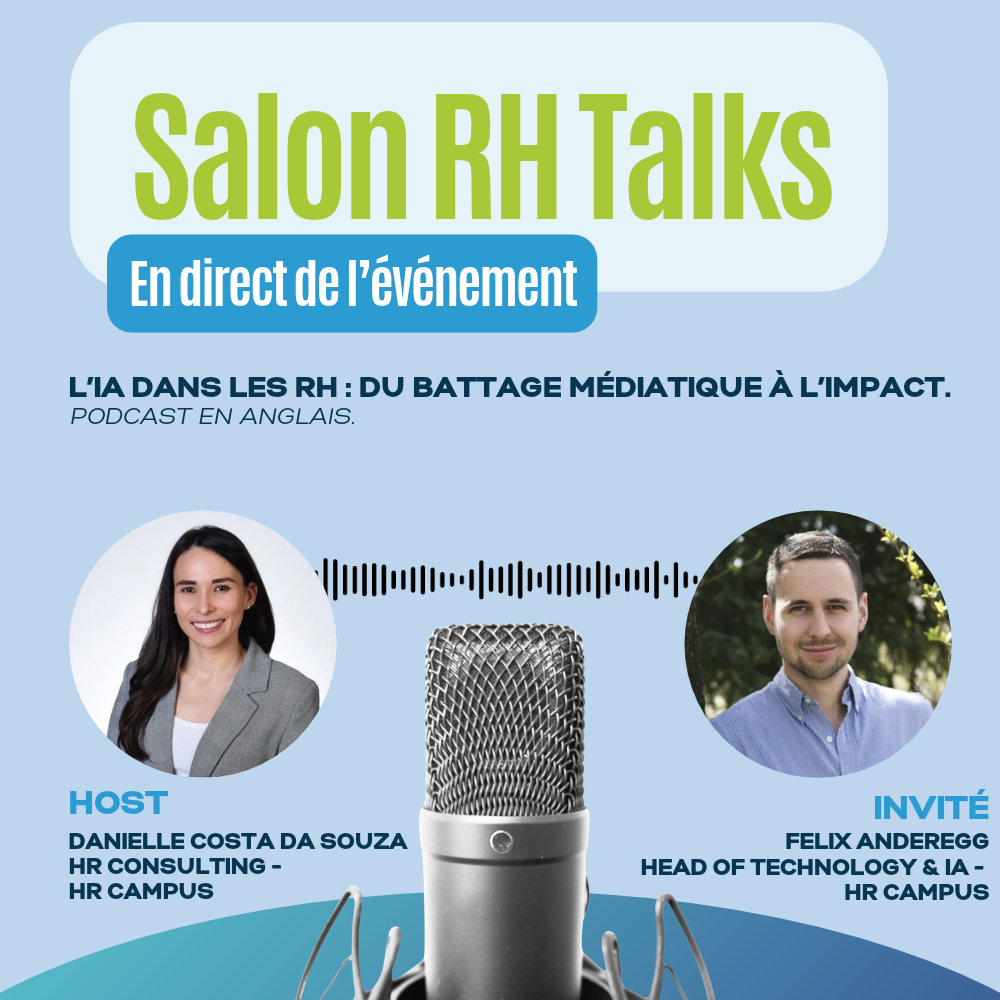
L’IA dans les RH: du battage médiatique à l’impact.
- Animé par
- Danielle Costa da Souza
- Invités
- Felix Anderegg
Dans cet épisode
Felix Anderegg (HR Campus) distingue les usages déjà utiles de l’IA dans les RH des promesses d’autonomie encore peu fiables, avec la gestion des frais comme exemple concret. La priorité est de sélectionner quelques problèmes à résoudre, de mesurer les bénéfices et d’adapter la gouvernance au risque. Les décisions qui affectent les personnes doivent rester sous responsabilité humaine.
Points clés
- La valeur de l’IA se mesure au temps réellement gagné, à la qualité améliorée, aux frictions réduites et à l’expérience des utilisateurs, pas au seul volume d’utilisation.
- Les premiers cas d’usage doivent partir d’un travail lent, répétitif ou freiné par un accès difficile à l’information, plutôt que du choix d’un outil.
- La gestion des frais offre un cas concret : lecture des justificatifs, extraction des informations et aide à la catégorisation réduisent les saisies manuelles.
- Les contrôles doivent être proportionnels aux conséquences : plus une décision affecte une personne, plus le jugement humain et la possibilité de modifier le résultat comptent.
- Commencer avec quelques cas d’usage permet d’apprendre à utiliser, vérifier et intégrer l’IA ; cet apprentissage ne se rattrape pas instantanément.
L'épisode en détail
La gestion des frais, un exemple de valeur concrète
Lire des justificatifs, extraire les informations utiles et aider à catégoriser les dépenses : la gestion des frais montre comment l’IA peut alléger un processus répétitif sans devenir le centre de l’attention. Felix Anderegg (HR Campus) présente cet usage en réponse aux questions de Danielle Costa da Souza (HR Campus) sur les bénéfices déjà observés dans le travail quotidien.
Le processus concerne de nombreux collaborateurs, comporte beaucoup de manipulations répétitives et produit des résultats vérifiables. L’intérêt réside dans la diminution des saisies manuelles, une information mieux structurée et un parcours demandant moins d’efforts aux personnes concernées. Une IA utile peut ainsi rester presque invisible.
D’autres bénéfices apparaissent dans le développement logiciel, la recherche d’informations, la préparation de premiers brouillons, la documentation et la structuration de contenus complexes. Mais Felix Anderegg distingue clairement l’usage de la valeur : utiliser un outil ne prouve pas que le travail s’améliore.
L’évaluation doit donc porter sur des effets concrets : un gain de temps significatif, une meilleure qualité, moins de frictions ou une meilleure expérience pour les collaborateurs et les clients. La question centrale n’est plus seulement celle des possibilités techniques, mais celle du travail que les RH peuvent mieux accomplir grâce à l’IA.
Partir du problème plutôt que multiplier les outils
Pour identifier les premiers usages pertinents, Felix Anderegg propose de chercher les tâches lentes, répétitives, frustrantes ou dépendantes d’informations difficiles à trouver. Cette démarche permet de partir d’un besoin réel plutôt que d’un outil à déployer à tout prix.
Les demandes rencontrées concernent notamment la productivité individuelle, l’accès aux connaissances RH, les flux de travail assistés par l’IA et l’aide à la décision. Certaines organisations arrivent avec un processus précis à améliorer ; d’autres savent surtout qu’une action sur l’IA devient nécessaire. Selon Felix Anderegg, la plupart disposent désormais d’une assez bonne compréhension des possibilités. Le défi tient davantage à la priorisation qu’au manque d’idées.
L’accompagnement décrit par HR Campus suit trois étapes :
- L’orientation : évaluer la situation de l’organisation, les problèmes qui méritent d’être résolus et les fondations disponibles.
- Le développement des capacités : renforcer les compétences, la gouvernance et la confiance nécessaires à un usage responsable.
- La mise en œuvre : concevoir et développer des cas concrets, notamment des agents RH et des flux de travail assistés par l’IA.
L’objectif ne se limite pas à produire un prototype convaincant. La solution doit trouver sa place dans l’organisation, pouvoir être exploitée de manière responsable et apporter une valeur visible. Cela suppose de considérer ensemble les données, les processus, les personnes et la gouvernance, au-delà du modèle utilisé.
Adapter les contrôles aux conséquences des décisions
Une démonstration impressionnante ne constitue pas encore un processus fiable. Felix Anderegg oppose ainsi l’utilité déjà accessible d’un assistant préparant une communication RH aux exigences bien plus fortes d’un dispositif qui sélectionnerait des candidats ou prendrait des décisions d’embauche et de licenciement.
La confidentialité, la protection des données, les résultats peu fiables, les biais et la transparence font partie des préoccupations évoquées. Pour y répondre, la confiance doit être intégrée dès le départ, avec des règles claires sur les données, les outils autorisés et la validation des résultats.
Cette gouvernance doit rester pratique et proportionnée au risque. Les usages à faible risque peuvent demeurer simples, tandis que les applications aux conséquences importantes nécessitent davantage de contrôles. Des décisions bien définies, fiables et peu risquées peuvent être automatisées.
À l’inverse, lorsqu’une décision touche la carrière ou la situation personnelle, la responsabilité doit rester humaine. Plus l’impact est fort, plus le jugement humain, la transparence et la possibilité de modifier le résultat deviennent indispensables. L’IA peut structurer l’information, mais ne doit pas servir à déléguer la responsabilité.
Construire une capacité collective et préserver le choix humain
Felix Anderegg anticipe un passage de l’assistance individuelle à une capacité organisationnelle. Au lieu de simplement répondre à des questions dans une interface, des agents pourraient intervenir entre plusieurs sources d’information et systèmes, soutenir des processus définis et solliciter une personne lorsque son jugement est nécessaire.
L’accès aux services RH pourrait évoluer de la même manière. Un collaborateur exprimerait un besoin, comme comprendre une fiche de paie ou préparer un congé parental, sans devoir d’abord identifier le bon portail, le bon processus ou le bon interlocuteur. L’IA pourrait alors fournir des informations et guider les étapes nécessaires.
Cette perspective ne supprime pas l’intérêt du contact humain. Une question sur une fiche de paie posée tard depuis le domicile peut se prêter à un agent ; au bureau, demander directement à une personne reste pertinent. Les préférences diffèrent également selon les individus.
Pour les prochains mois, la priorité proposée consiste à sélectionner quelques usages, établir une gouvernance claire et apprendre à mesurer les améliorations. Attendre présente surtout un risque de retard d’apprentissage : savoir quand faire confiance à l’IA, quand contester un résultat et comment intégrer ces outils au travail demande une expérience qui ne s’acquiert pas instantanément.
Questions et réponses
Dans la recherche et la structuration d’informations, la préparation de brouillons, la documentation et les tâches répétitives. La gestion des frais illustre ces bénéfices : l’IA lit les justificatifs, extrait les données utiles et aide à classer les dépenses, avec moins de saisies manuelles.
Les décisions qui affectent la carrière ou la situation personnelle exigent une responsabilité humaine. L’IA peut préparer et structurer les informations, mais plus les conséquences sont importantes, plus le jugement humain, la transparence et la possibilité de modifier le résultat sont nécessaires.
Par un petit nombre de problèmes concrets à résoudre, et non par une accumulation d’outils. Il faut examiner les fondations disponibles, développer les compétences et une gouvernance pratique, puis mettre en œuvre des usages dont les effets sur le travail peuvent être mesurés.
En permettant aux collaborateurs d’exprimer directement un besoin, comme comprendre une fiche de paie ou préparer un congé parental, plutôt que de chercher le bon portail ou interlocuteur. Des agents pourraient relier les informations et les étapes nécessaires, tout en sollicitant un humain lorsque son jugement est requis.
Transcription
Lire toute la conversation Replier la conversation Texte intégral
[00:00:01] Intro: Bienvenue dans Salon RH Toolkit, le podcast officiel du salon RH, le rendez-vous incontournable des professionnels des ressources humaines en Suisse romande. Pendant le salon, nous avons donné la parole à celles et ceux qui font évoluer le monde du travail experts, responsables RH, dirigeants et acteurs de l'innovation. Des regards croisés, des expériences concrètes et des idées inspirantes pour mieux comprendre les enjeux d'aujourd'hui et imaginer les RH de demain. Installez vous confortablement et plongez au cœur des conversations du salon RH. Bonne écoute!
[00:00:36] Danielle Costa da Souza: Hello Felix. How you doing?
[00:00:39] Felix Anderegg: I'm good and you.
[00:00:40] Danielle Costa da Souza: I'm good. Thank you. First of all. Thank you so much from coming. All the way from Schaffhausen to Lausanne. I know it's quite a journey. But thank you so let's go right into it. Today we talk about artificial intelligence. It's everywhere at the moment. We hear about Chatgpt, Copilot. Agency and automation every day. At HR Campus, we work at the intersection of HR technology and people. So today, I'd like to take a closer look at AI what I really means for HR and not just in theory, but based on what we are already seen and experiencing at our own work and who better than to talk about this than you and you are at our head of technology and AI. And so thank you so much for being here Felix when people talk about AI in HR there is often a lot of excitement and a lot of hype from your perspective. Where do you already see AI are creating real value today and where do you think expectations are still ahead of reality?
[00:01:49] Felix Anderegg: Well, I think we are moving from facination to applications and AI already create real values when it supports knowledge work, it helps people to find and structure information create content analyze data complete repetitive tasks more efficiently. We are also beginning to see the next step, AI agent support supporting define the part of HR process. Rather than simply answering questions, but expectations are still ahead of reality when we talk about fully autonomous HR. And impressive demonstration is not yet a reliable process and a technical possible use case is not automatically responsible and reliable one for example. A copilot that help prepare of an HR communications can already be useful, but impressive demonstration that screens candidate and higher of fires them is not yet reliable fair and accountable recruiting process so for me the real question is no longer what AI can do it is what can HR do better because of AI. That change of perspective takes away from technology and for technology’s sake and towards actual business value.
[00:03:12] Danielle Costa da Souza: Ok, thank you and has your view changed as AI has developed over the last couple of years.
[00:03:20] Felix Anderegg: Yeah, A few years ago I focused on what technology can do and today I focus much more on whether an organization can use it responsibly repeatedly and at scale. that's why the model matters, but so do data process people and governance.
[00:03:37] Danielle Costa da Souza: And if we look specifically at HR Campus. Where do you already see AI making a difference in our daily work.
[00:03:44] Felix Anderegg: At HR Campus, AI is moving from each individual experience to organizations with capability our experience did not begin with Chatgpt which we started with Sophie our digital assistant in 2018 and Eddie in 2019. today our campus AI transformation brings the work together through enablement adoption the AI Lab and AI Education. Our key users for example help teams identify practical use cases and apply AI safely in their work in their own work at this time I landscape.
[00:04:30] Danielle Costa da Souza: It's so exciting to see how things are moving forward and how we are addressing the AI topic and then are there already examples we've seen a real benefits, whether that's saying that saving time, improving quality or simply making process easier.
[00:04:51] Felix Anderegg: Yeah a lot of. So obvious one for Tech guy is software development, of course, but we see benefit in finding information. Preparing first draft Documenting work Structuring complex materials. But the usage alone, it is not value. we ask whether AI save meaningful time improved quality reduce friction or create a better employee our customer experience.
[00:05:15] Danielle Costa da Souza: Yes sure. Is there a particular AI use case or initiatives where you would say this is a really good examples of AI creating tangible values and what have we actually gained from it?
[00:05:28] Felix Anderegg: Yes I think a good example is steady. Our intelligent expense and travel management solutions. Expense management is not the most glamorous process in a HR, finance. But that is exactly why is such a good use case. It affects many employees contain a great deal of repetitive work and produces resorts that can be checked, read receipts. Extract relevant information and support the categorization of and allocation of expenses and of course a lot more like for and for assistance and stuff like that the value is tangible less manual work, less manual data entry better structured information and smoother process for everyone involved what I like about this use case or these examples is that AI is not a store of the of the process ideally uses barely notice it simply experience a process that requires at simply experience a process that requires less efforts that is often where AI create the most value, you know when it looks like spectacular and everything is wow, but when it quietly removed the friction.
[00:06:45] Danielle Costa da Souza: I can see that I mean I barely see that Eddy has any AI more than it to be honest well at my point where I used it. But yeah, it's great to to know that it can be used in that way to and looking what you're saying through your role and the project we're working on what kind of AI topics and use cases are currently coming up most often in the HR world.
[00:07:13] Felix Anderegg: Well, I'm not lack of ideas and they lack of priorisation. We see interest in personal productivity HR knowledge excess, AI supported workflows and decision support. Some organization of a specific process or problem others simply you know that they need to do something with AI. instead of starting with a tool, we look for work that is slow repetitive frustrating or dependent on information that is difficult to access that usually reveals the most relevant First use case. So we start with the problem, not with the tool.
[00:07:59] Danielle Costa da Souza: But are there company already approaching AI with concrete ideas or are many of them still trying to figure out where it actually makes sense for them know today.
[00:08:11] Felix Anderegg: No, today most of company have quite a good level of information and know what is possible or not to be a better use case or worse one so most of the company have a good idea of how they could use it.
[00:08:27] Danielle Costa da Souza: Ok, One topic that often comes up when talking about a trust. In HR, we're dealing with people, personal data and important decisions. What concerns our organization raising most often and how should HR teams address them?
[00:08:42] Felix Anderegg: Well in my opinion, trust must be built into the use of AI and not added afterwards. That's important Switch in the head. So HR organizations are concerned about privacy confidentiality, unreliable results by us. Transparency you name it. They need clear rules for data and approved tools, validation, things like that.. governance should also be practical and risk based and so low risk use remain easy while consequential applications received stronger controls. AI may help structures for example information for hearing decisions, but when the decision affects the carrier or personal personal things, a human must remain accountable. That's important and I should not become the way for human to outsource the Responsibility.
[00:09:51] Danielle Costa da Souza: Ok, So where do you think organization should draw the line between when AI can support and what should remain a human decision?
[00:09:59] Felix Anderegg: I would drop it based on impact. Low risk clearly defined and reliable decisions can be automated. No problem. The more, the decision affects the person, the stronger, the need for human judgement, transparency and the possibility to change the outcome has to be here.
[00:10:20] Danielle Costa da Souza: So I have an interesting question for you. So looking ahead at what you're personally most excited about what it comes to AI in HR and if you had to give HR leaders one piece of advice for the next twelve months. What would it be? Where should they focus their attention when it comes to AI?
[00:10:45] Felix Anderegg: I’m most excited about the shift from individual assistance, to organizational capability. So today most people experience AI through interface ChatGPT, Claude.. you name it. They ask a question receive an answer and continue working. In the future, in my opinion, AI become more deeply embedded into workflows agents will work across information sources and systems support defined process and involve human where judgement is needed. And that could remove a great deal of the administrative functions from HR, but my advice for the next twelve months is not to deploy as many tools as possible. Build capability. Select a small number of use cases create clear but practical governance and learn how to measure whether AI actually improve the work. The organization that succeeded will not be those with the large number of our collection of tools. They will be those that learn faster how to read design workaround them. So don't compete on access on AI, compete on the ability to use them well.
[00:12:07] Danielle Costa da Souza: Well ok, interesting. So imagine an HR department not to really seriously invest in a high over the next two years. What do you think they will struggle with compared to organizations that do?
[00:12:24] Felix Anderegg: You are well? Good luck! the biggest risk is not immediately relevant is growing learning help you get! Organizations that start and now experience with use cases governance data process and things like that they are employees learn how to trust AI, when to challenge it and how to integrated into their work. That experience cannot be acquired in instantly later. A department that waits, may continue to spend more time searching for knowledge, handling administrative, work and depending on the individual expert. While organization steadily improve how they deliver HR services. If you wait two years, you are not only two years behind in technology. You are two years behind in learning.
[00:13:16] Danielle Costa da Souza: Yeah, That's why we have our AI key users HR Campus.
[00:13:25] Felix Anderegg Maybe that's one of the reasons
[00:13:26] Danielle Costa da Souza: so I'm looking forward to seeing how that goes and to implement that in our organization. Yeah. So for HRs leaders listening today the question might be that this sounds promising. But where do we actually begin? How is HR Campus helping organisations turn your AI interesting to an interesting topic in the real business value?
[00:13:51] Felix Anderegg: So we help organizations to move from Curiosity to capability and from capability to impact. We help organizations move through this three stages basically first orientation. We assess where the organization stands which problem are worth solving and whether the required foundations are in place. Second enablement, we help HR teams build the skills, governance and confidence required to use AI responsibly. Third, implementation, we designed and develop concrete use-case, including HR agents and AI supported workflows. What differences us? Our HR Campus is that we combine HR expertise; knowledge and technical implementation. We do not begin with the model or the tool has already mentioned. We begin with the work that needs to improve and we don't want to stop with an inspiring prototype. The goal is a solution that fits in the organization and can be operated responsibly and create visible values. I think that's it.
[00:15:12] Danielle Costa da Souza: Ok? So another question. Let's get into your head and imagine we meet again in two years time and we do podcast again about HR and hum AI, I mean and HR and what's one thing in HR that you think AI will have fundamentally changed?
[00:15:34] Felix Anderegg: I think AI will fundamentally change how our employees access HR. Today employees often need to know which system to open, which process to follow or which person to ask. In the future, they will increasingly express the intentions and AI will translate into information: guidance, processes depth across the system, so an employee will take a parental leave or I don't understand my payslip. Instead of searching for the right portal or person or whatever…The answer comes from AI. And AI will not make HR less human. Used well, it will allow HR to be more human where it really matters.
[00:16:25] Danielle Costa da Souza: Ok, so if I have a question about my payslip in two years time, I'm just gonna ask my AI and that is implemented in the organization, and then it might be given give me the answer like a knowledge base.
[00:16:41] Felix Anderegg: Yeah, why not because it's like really technical case so to say and I think imagine you are at home, in the home office. Maybe it's already late in the evening and you watch your payslip and have a question. You are not able to call someone. Then you can ask your agent. If you are at the office next to the office. Why don't walk to the next door and ask it’s, it's like common sense.
[00:17:14] Danielle Costa da Souza: Yeah sure of course. Looking forward to seeing it. I mean, you have like knowledge bases that are already helpful. But I think like humans enjoy when they can ask the questions right away and get an answer, instead of having to look for it like it's easier to ask something than to you. I mean to ask. Sometimes it's difficult to ask the right question and so when you can ask a tool that is gonna do the the searching for you. It might be easier. Of course. I can understand that.
[00:17:45] Felix Anderegg: It depends on the individual person, some prefer to ask a system and other one of a human. So it's not the same and everyone.
[00:17:55] Danielle Costa da Souza: Will see how, how HR is gonna evolve and the next couple of years and how AI is gonna make people's life easier. I hope the humanity will stay. First of all, thank you very answer and how we are going to yeah to implement AI even if you're doing to our processes and solutions.
[00:18:24] Felix Anderegg: Thank you.
[00:18:27] Intro: Cet épisode vous a plu? Alors retrouvez nous la prochaine fois en live! Les 6 et 7 octobre 2027 à Beaulieu, Lausanne. Plus d'infos sur SalonRH.com. A bientôt!
Autres épisodes
Tous les podcasts
Genre et transidentité en entreprise.
Le prénom d’usage, la confidentialité et la formation sont au cœur de l’accueil des personnes trans au travail. Léon Salin (Association Salin) et Jennifer Petterson (Ville de Crissier) abordent le recrutement et l’accompagnement d’une transition en emploi. Leur conclusion : vérifier les outils RH et préparer les équipes avant qu’une situation se présente, plutôt que d’attendre pour agir.

Vos équipes utilisent l’IA au quotidien, et vous ?
Une charte, un outil principal et une cartographie des usages : Matthieu Corthésy (Outil-là) présente les préalables à une formation IA avec Chloé Humbert-Droz (tipee). L’échange aborde les coûts, la confidentialité et l’évolution des tâches RH. La conclusion : fournir plusieurs outils adaptés, accompagner les équipes et préserver les compétences humaines plutôt que tout automatiser.
ATS, outils de feedback, intelligence artificielle : quand la tech RH nous éloigne du terrain.
Anne Donou (Alixio) décrit un passage de 50 à 100 dossiers grâce à l’IA, accompagné d’une surcharge mentale. Avec Rémi Bloch (SAI ERP) et Yann-Eric Dizerens (Services industriels de Genève), la discussion explore les limites des ATS, l’inflation du reporting et le risque de déqualification. La conclusion : partir d’un besoin précis, former les équipes et vérifier que le temps gagné améliore réellement les relations et les compétences.

Quand l’IA se trompe… encore: Mode d’emploi pour bien l’utiliser.
Une réponse plausible de l’IA n’est pas forcément juste. Madeline Plard (Lucca Software Sárl) détaille les erreurs liées au contexte manquant, aux données incomplètes et à la complaisance, puis les usages pertinents en recrutement, performance et formation. La conclusion : vérifier les résultats, protéger les données et conserver le jugement humain.
